
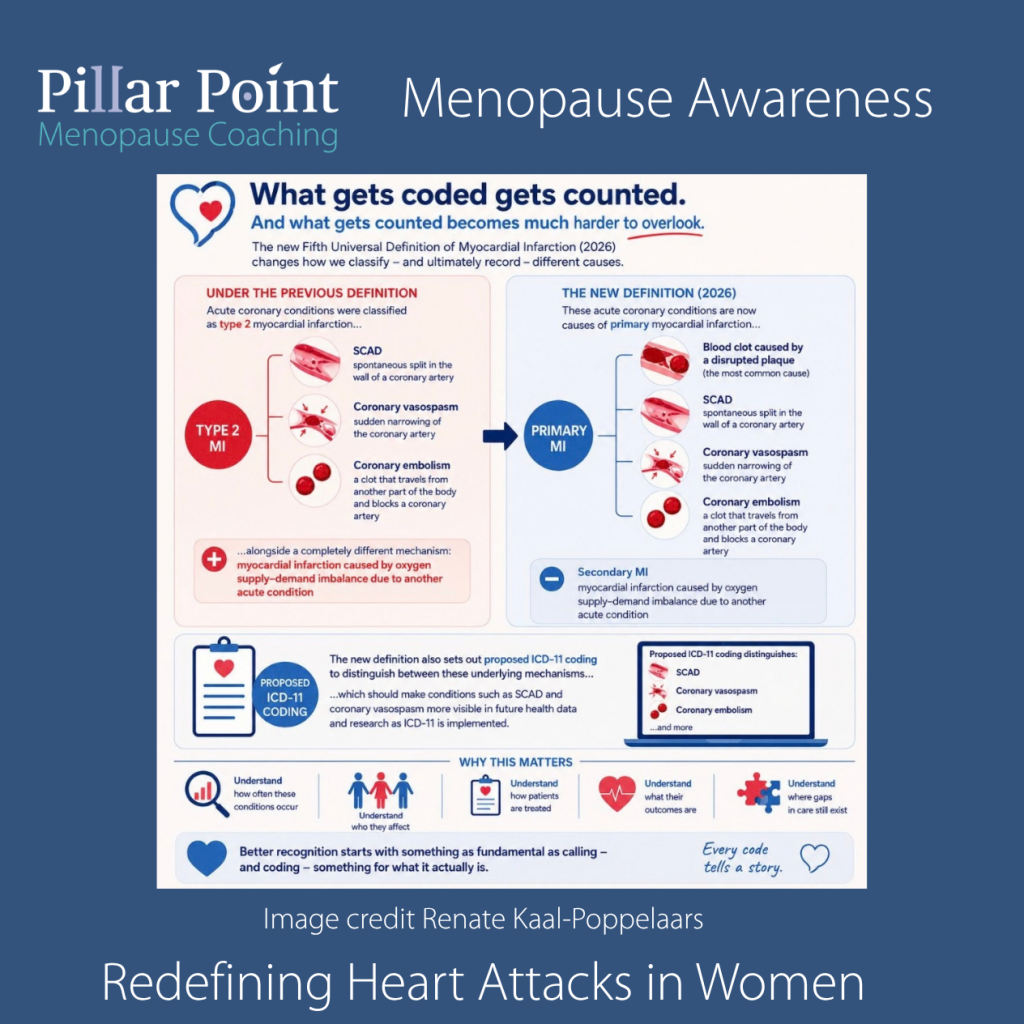
The global medical definition of a heart attack has changed. The Fifth Universal Definition of Myocardial Infarction (UDMI), jointly published by four major international cardiac societies, radically alters how female-pattern heart attacks are categorised, diagnosed, and treated.
The previous numerical system (Types 1-5) often led to female heart attacks being sidelined or incorrectly medicated. The new guidelines discard this in favour of three distinct clinical settings: Primary, Secondary, and Procedure-related myocardial infarctions (MI). Crucially, the guidelines mandate sex-specific diagnostic thresholds to prevent the systematic under-recognition of cardiac events in women.
Why the Guidelines Changed Historically, cardiovascular diagnostic models focused almost exclusively on male-pattern plaque ruptures (atherothrombosis). If a woman presented with a heart attack caused by a different mechanism, it was often classed as a ‘Type 2’ event, which some experts argue led to these cases being deprioritised.
The Fifth UDMI corrects this bias. It now formally classifies the following acute coronary pathologies as Primary MI:
- Spontaneous Coronary Artery Dissection (SCAD): A sudden tear in the wall of a coronary artery. Approximately 80 per cent of SCAD cases occur in women.
- Coronary Artery Spasm (Vasospasm): A severe, temporary constriction of the heart vessels that deprives the heart muscle of oxygen.
- Coronary Embolism: A blood clot that travels from elsewhere in the body to block a coronary artery.
How This Impacts Your Care These specific mechanisms require completely different treatments than traditional obstructive heart attacks. Prescribing standard post-heart-attack medication, such as certain blood-thinners or statins, to a SCAD patient can be ineffective or actively harmful. The new guidelines enforce three major changes to standardise care:
- Sex-Specific Troponin Thresholds: Troponin is a protein released during heart muscle damage. Women naturally exhibit lower baseline troponin levels than men. Hospitals are now required to use sex-specific 99th percentile upper reference limits. Using a single universal threshold previously caused a systematic bias that missed female heart attacks.
- Mandatory Imaging: An elevated troponin level indicates myocardial injury, but it does not diagnose a heart attack on its own. The guidelines state there must be clinical evidence of ischaemia. Doctors are now encouraged to use targeted imaging (such as an angiogram or echocardiogram) to pinpoint the exact acute coronary pathology rather than assuming plaque rupture.
- ICD-11 Alignment: The new diagnostic criteria align with International Classification of Disease (ICD-11) coding. This allows healthcare systems to accurately track the incidence of less common mechanisms like SCAD and vasospasm, improving future research for women’s heart health.
Recognising the Symptoms Female heart attacks frequently present without the classic crushing left-arm pain. You must recognise the alternative signs. Symptoms often include:
- Unexplained, extreme fatigue
- Breathlessness
- Discomfort or pain in the jaw, neck, or upper back
- Nausea or dizziness
Understand these symptoms and advocate for yourself. If you suspect a cardiac event, insist on an ECG and a troponin test evaluated against female-specific thresholds.
References:
- Mills, N., Newby, K., Zaman, S., et al. (2026). Fifth Universal Definition of Myocardial Infarction. European Heart Journal, ehag101. https://doi.org/10.1093/eurheartj/ehag101